Quick Navigation by Topic: Procurement Conditions (Q1, Q2, Q9) | Compliance & Safety (Q3, Q5, Q6) | Execution & Service (Q4, Q7, Q8, Q10)
Q1: What is the price range and minimum order quantity for emergency relief sleeping bags?
Pricing for bulk emergency relief sleeping bag procurement is influenced by several factors simultaneously: outer shell fabric specification (e.g., 210T polyester plain weave, nylon blends), fill type and weight (hollow-fiber polyester fill weight typically ranges from 300g to 800g depending on the temperature rating required), the applicable temperature range, the degree of customization required, and freight costs to the destination country. The combined effect of these variables can produce significant differences in unit price.
Reference MOQ tiers are as follows: small-quantity trial orders typically begin at the low hundreds of units, with a higher unit price; mid-scale standard projects typically fall in the range of several hundred to several thousand units; government-stockpiled emergency relief sleeping bags or large-scale NGO aid projects can discuss consolidated procurement arrangements based on total volume and cooperation duration. Distributors are encouraged to share their target market scale upfront so that a long-term pricing structure and regional cooperation strategy can be jointly developed.
Professional Procurement Tip: Before reaching out for quotes, define your target temperature rating and fill-weight range first — a single-tier difference in specification can translate into a substantial unit price gap. Leading with spec clarity is more cost-effective than leading with price requests. It is also not advisable to use the lowest unit price as the sole decision criterion before specifications are locked, as this frequently results in insulation performance failures or durability shortfalls at the inspection stage.
Q2: How long does production and delivery take? Can rush orders be accommodated for urgent projects?
Lead times are shaped by the current order backlog, product specification complexity, and raw material availability. Specific delivery milestones should be established in the signed contract; no fixed rush timelines are committed to for projects that have not yet been formally contracted.
For time-critical needs such as rapid distribution of sleeping bags to disaster resettlement sites, production prioritization is possible to a reasonable extent under favorable conditions — but rush capacity is subject to the real-time constraints of production loading and material inventory. The more effective strategy is to lock in production capacity through a framework agreement or advance procurement before a disaster occurs, rather than attempting to coordinate emergency sourcing after one strikes. This pre-positioning approach is widely adopted by emergency management agencies in numerous countries at the preparedness stage, and is a central recommendation in the decision-making pathway covered later in this FAQ guide.
Q4: Is customization available for specifications, fabric, zipper design, and packaging?
OEM/ODM customization is supported. The core configurable dimensions for emergency relief sleeping bag custom configurations are as follows:
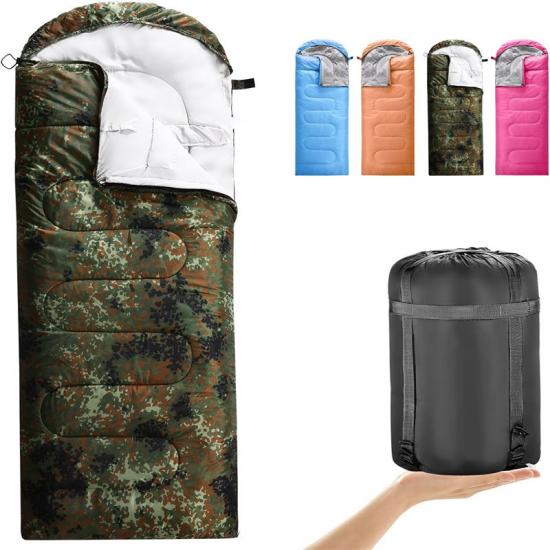
(1)Cut and Size: Standard adult sizing (typically approximately 190×75 cm), children's and youth reduced sizing, and an extended-length emergency relief sleeping bag (approximately 210×80 cm) designed for taller first responders. Procurement ratios across size categories can be flexibly adjusted to match the age and body-size profile of the intended beneficiary population.
(2)Fill Weight and Temperature Rating: Standard versions typically cover a temperature range of 0°C to +10°C; cold-weather insulated emergency sleeping bags in the high-warmth configuration typically cover -10°C to 0°C. Both versions can be independently specified to meet the differentiated climate requirements of different project regions.
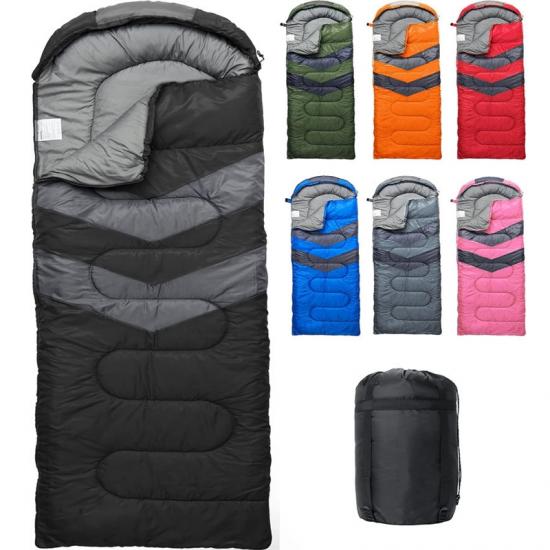
(3)Zipper and Structural Design: Options include single-side opening zippers, two-way zippers, and anti-snag zipper guard tape. Shell profiles can be specified as envelope-style (suitable for general disaster resettlement sites, easy to open and use) or mummy-style (suited to cold climates, with superior insulating wrap coverage).
(4)Branding and Packaging: Fabric color, printed identification (organization logo, batch number, etc.), and packaging label languages (including recipient-country local language versions) are all customizable. Neutral unbranded versions and private-label production are both available; any identification marks must be confirmed in writing by the client before production commences.
Special Population Configuration Note: For beneficiary groups including children, elderly persons, and injured individuals, it is recommended to specify safety requirements explicitly in the procurement specification document — such as freedom from harmful substances, no exposed sharp seam edges, and accessible zipper operation. These are standard review dimensions under NGO beneficiary protection policies and should be incorporated into scope definition at the procurement initiation stage, rather than raised as supplemental requirements at the inspection phase.
Nature of Goods: Cold-weather insulated emergency sleeping bags are classified as civilian daily-use textile goods and are not subject to weapons or dual-use export controls. If the destination country maintains specific trade restrictions, this should be disclosed before order confirmation so that feasibility can be jointly evaluated prior to proceeding.
Q6: Are emergency relief sleeping bags suitable for long-term stockpiling? How should they be stored, and how often should stock be rotated?
These products are well-suited for inclusion in a standard emergency supply stockpile management system. Proper storage practice directly determines the operational readiness and service life of the stockpile — neglecting this dimension is one of the most common causes of large-scale stockpile failure at the point of activation.
Storage Condition Requirements: Maintain a dry, well-ventilated environment (relative humidity ideally below 60%); avoid extreme high temperatures (recommended maximum 40°C) and sustained low-temperature fluctuations; protect from prolonged direct sunlight; store on pallets to prevent direct ground contact.
Practical Notes for Large-Scale Stockpiling: Standard practice in government warehouses and NGO storage facilities is to use vacuum compression packaging to maximize storage density. This is a rational and widely used approach in high-volume scenarios and differs from individual care recommendations. An important consideration: vacuum compression storage exceeding approximately two years may reduce fill loft; units should be unpacked and allowed to reflate for 12 to 24 hours before distribution. Batches stored for more than three years should be subjected to spot inspection, with focus on fill loft recovery and outer shell fabric integrity.
Rotation Mechanism Recommendation: Batch rotation can be linked to training exercises or small-scale relief operations — deploy near-expiry stock in active missions while replenishing with new batches. This prevents large-scale simultaneous disposal while continuously validating the real-world condition of the stockpile. It is recommended to maintain an emergency relief sleeping bag inventory ledger recording batch numbers, receipt dates, and inspection outcomes for audit tracking and compliance management.
Q7: Can you support international shipping arrangements and customs documentation preparation?
Our primary role is as the upstream supply source for bulk emergency relief sleeping bag procurement, not as a freight forwarder — this distinction is worth clarifying at the project initiation stage.
On trade terms, we support FOB, CIF, EXW, and other standard Incoterms, with specific service boundaries defined in the contract. For documentation, we can prepare commercial invoices, packing lists, certificates of origin, inspection certificates, declarations of conformity, and packaging label language adaptations to meet destination country requirements. We maintain long-term working relationships with multiple international freight forwarders and can assist in recommending logistics solutions tailored to destination routes.
For time-sensitive urgent projects, we can assist in coordinating multi-batch shipments to distribute the risk of single-consignment delays. However, final transit times are subject to route availability, port conditions at the destination, seasonal factors, and local trade policy — contract time clauses should maintain reasonable flexibility, with clear definitions of force majeure boundaries.
Q8: How are quality issues handled? What should be checked during goods receipt inspection?
For quality issues attributable to manufacturing, we accept responsibility within the contractually agreed warranty period and will address confirmed defects through supplementary supply or replacement, subject to submission of batch numbers, written issue descriptions, and photographic or video evidence. Deterioration caused by use beyond designed temperature ratings or by improper storage falls outside warranty coverage.
Emergency relief sleeping bag goods receipt inspection checklist — the following five dimensions are recommended for systematic verification:
(1)Appearance and Workmanship: Randomly inspect a sample of units for damage, staining, loose threads, significant color inconsistency, and check zipper smoothness and anti-snag guard tape integrity;
(2)Dimensions and Weight: Measure key dimensions (length, shoulder width, foot width) and individual net weight against the specification document; confirm deviations fall within agreed tolerance ranges;
(3)Fill Loft: Open a random sample and observe fill recovery and loft condition relative to the confirmed pre-production sample;
(4)Fabric and Labeling: Verify that composition labels, care symbols, batch numbers, and packaging label language match contract specifications;
(5)Quantity Verification: Verify actual received quantity against the packing list and contract, including carton-by-carton quantity confirmation at multiple levels.
Any issues identified at the inspection stage should be communicated to the supplier in writing immediately, and resolved through the contractual process before affected goods enter the warehouse or distribution stream. Government and NGO projects are advised to retain complete inspection records for audit purposes.
Q10: How do governments, NGOs, and distributors initiate an emergency relief sleeping bag procurement project?
Regardless of the role, the key to an effective start is explaining the requirement clearly before requesting a price:
Step One (Universal): Provide a project overview covering the application scenario (e.g., earthquake resettlement site, flood emergency camp), the number of beneficiaries to be covered, the target climate zone and approximate minimum temperature, special population composition (whether children, elderly, or injured persons are included and in what proportion), usage duration (short-term temporary or medium-to-long-term resettlement), and an approximate budget range.
Step Two (Initial Proposal): Based on project experience, an initial configuration recommendation will be provided, including suggested temperature rating version and specification mix, an indicative price range, and a preliminary delivery timeline assessment.
Step Three (Formal Progression): Both parties refine technical specifications, customization requirements, and delivery schedule; confirm whether additional certifications or special documentation are required; and proceed into the formal inquiry or contract process.
Government and NGO procurement teams that have already drafted tender documents may share technical clauses in advance — subject to internal compliance rules — to receive implementation-level risk notes and configuration optimization input. Distributors who provide early clarity on their target market scale and primary client type will enable a jointly designed product range better suited to long-term sales and competitive tendering.
What Are the Core Supply Chain Advantages of Sourcing Emergency Relief Sleeping Bags from China?
For cross-border government-stockpiled emergency relief sleeping bag procurement and NGO aid project sleeping bag sourcing at scale, prioritizing Chinese source factories offers the following substantive advantages:
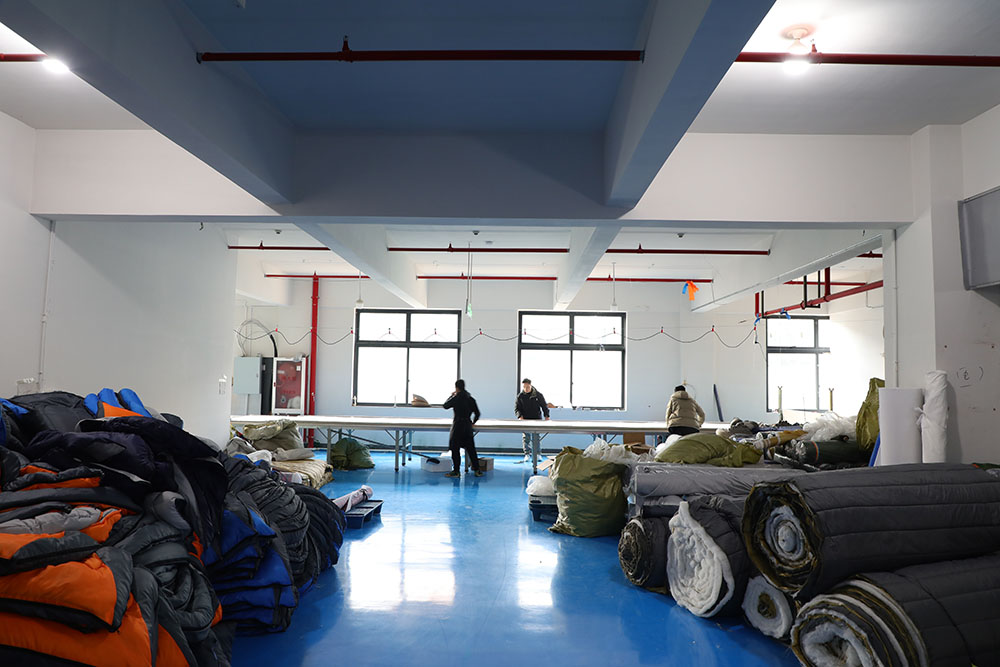
Complete Industrial Chain and Strong One-Stop Capability: The supply chain from outer shell fabric to fill material and accessories is highly concentrated in the same regional cluster. This makes it practical to procure sleeping bags and complementary items — such as emergency blankets, insulating sleeping pads, and storage backpacks — within a single supply ecosystem, reducing cross-supplier coordination overhead and improving overall project execution efficiency.
Volume Capacity to Support Large Orders: Established factories can handle orders ranging from thousands to hundreds of thousands of units of bulk emergency relief sleeping bags, meeting the production scale requirements of national-level stockpiling or large international aid projects, with accumulated experience in managing priority rush production.
Mature Export Service Infrastructure: Full export licensing is in place, with familiarity across common destination-country customs requirements. Multi-language documentation support and full-container sea freight coordination are available, effectively reducing compliance-related delay risk in cross-border projects.
Flexible Customization Across Multiple Standards: Temperature rating, shell profile, labeling, and packaging language can all be tailored to project requirements, accommodating the procurement standards of different countries without the need to relay specifications through multiple layers of intermediaries.
Recommended Next Steps
Three actions that can be taken immediately:
(1)Prepare a one-page project requirements summary covering the target population size, climate zone and minimum temperature, usage duration, special population proportion (children, elderly, injured), and budget ceiling. This document is the foundation for the efficiency of all subsequent steps;
(2)Request samples from two to three shortlisted suppliers and conduct a focused small-scale test against the inspection checklist criteria for key dimensions, fill loft, and zipper quality — complete physical confirmation before committing to full procurement;
(3)Lock the temperature rating, fill weight, delivery milestones, and non-conformance handling process in the formal contract before goods are produced — avoid negotiating core parameters after delivery, and eliminate project execution risk from the source.
Complete Decision Pathway After the FAQ
This page covers the core questions that arise in the early stages of bulk emergency relief sleeping bag procurement. The following further reading is recommended to build a complete decision chain: for a systematic overview of selection logic and inspection criteria, refer to How to Choose High-Quality Emergency Relief Sleeping Bags | 2026 Professional Buying Guide; for an assessment of the overall advantages and potential risks of sourcing from China, refer to Why Prioritize Chinese Suppliers for Bulk Procurement of Emergency Relief Sleeping Bags | 2026 Procurement Decision Guide; for a full walkthrough of government and NGO procurement processes and contract essentials, refer to the Emergency Relief Sleeping Bag Procurement Practical Guide | 2026 Full-Process Analysis for Government & NGO Projects.
Derechos de autor © Custom Disaster - Relief Bedding: Tents, Sleeping Bags, Blankets Reservados todos los derechos
el equipo profesional al servicio !